

From receipt to dispatch: Your roadmap for a year free of bureaucracy
The year 2025 has made e-billing the standard for receipt. Now, in January 2026, many GmbH managing directors are facing the next hurdle: the gradual obligation to ship and prepare for the 2027 sales limits.

The answer directly
2026 is the decisive transition year for your GmbH. While you have had to receive e-invoices since 2025, your turnover in 2026 will determine whether you will have to send mandatory e-invoices in the XRechnung or ZUGFeRD format from January 2027. If your previous year’s turnover exceeds 800,000 euros, your grace period for sending invoices ends on December 31, 2026.
initiation
Welcome to 2026. A year has passed since the e-invoicing requirement for receipt in the B2B sector was officially launched. Perhaps you’ve already become accustomed to the fact that your inbox is flooded with files that look like lettering at first glance but are pure gold for your bookkeeping. But while receiving should already be part of everyday life for all limited liability companies, the obligation to actively send is getting closer and closer. For you as a founder or managing director, this means: 2026 is the year of setting the course. It’s no longer just about meeting legal requirements, but using technology in a way that gives you time back. At mika, we know that bureaucracy often acts like a brake block. That’s why today we’re taking a look at how you Master e-bill 2026without losing focus on your core business.
TL; DR
In 2026, limited liability companies must plan the transition from simply receiving to actively sending e-invoices. Anyone with a turnover of more than 800,000 euros in 2026 must switch to formats such as XRechnung or ZUGFeRD from 2027 in order not to jeopardize the input tax deduction.
Key Takeaways
- 2026 is the year of monitoring sales: If your GmbH converts more than 800,000 euros, you must send e-invoices from 2027.
- Make a clear distinction between formats: Only XRechnung and ZUGFeRD meet the legal requirements for an e-invoice, whereas simple PDFs do not.
- Use e-billing as an efficiency turbo: With structured data, AI systems such as mika can almost completely automate your accounting.
The timeline for 2026: Where is your GmbH right now?
To understand what you need to do in 2026, let’s take a quick look in the rearview mirror and way ahead. Since January 1, 2025, Every German GmbH is committedto be able to receive e-invoices for domestic B2B sales. This means that you could no longer refuse to accept an XRechnung or a ZUGFeRD file. The year 2026 now serves as a buffer and preparation time for the next big wave.
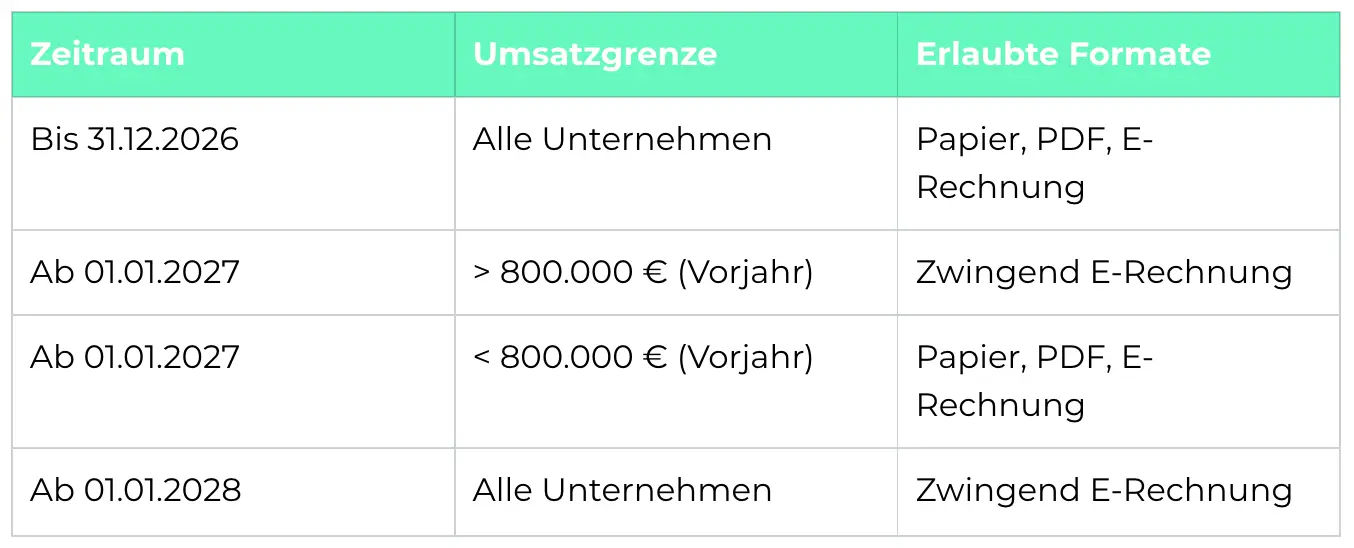
The most important number for you this year is 800,000 euros. Why Because your total turnover in calendar year 2026 determines how you start 2027. According to the Growth Opportunities Act and the supplementary Federal Ministry of Finance letters, the following levels apply:
- Until December 31, 2026: You can continue to send paper invoices or PDF invoices (with the recipient’s consent).
- From January 1, 2027: If your turnover in 2026 exceeded 800,000 euros, you must send e-invoices.
- From January 1, 2028: The shipping obligation applies to all companies, regardless of turnover.
For you, this means: If your GmbH grows and you break the 800,000 euro mark in 2026, you only have this one year left to convert your processes to automated shipping. But even if you stick with it, it’s wise to act now. Why wait until 2028 when you can benefit from faster payment terms and less manual effort today?
XRechnung vs. ZUGFeRD: Which format is right for you?
Time and again we hear the question: Is a PDF not enough? The clear answer is no. A pure PDF file is considered a “other invoice” under tax law from 2025/2026. A genuine e-bill must be included in a structured, machine-readable XML format that complies with EU standard EN 16931. There are two standards established in Germany that you should know.
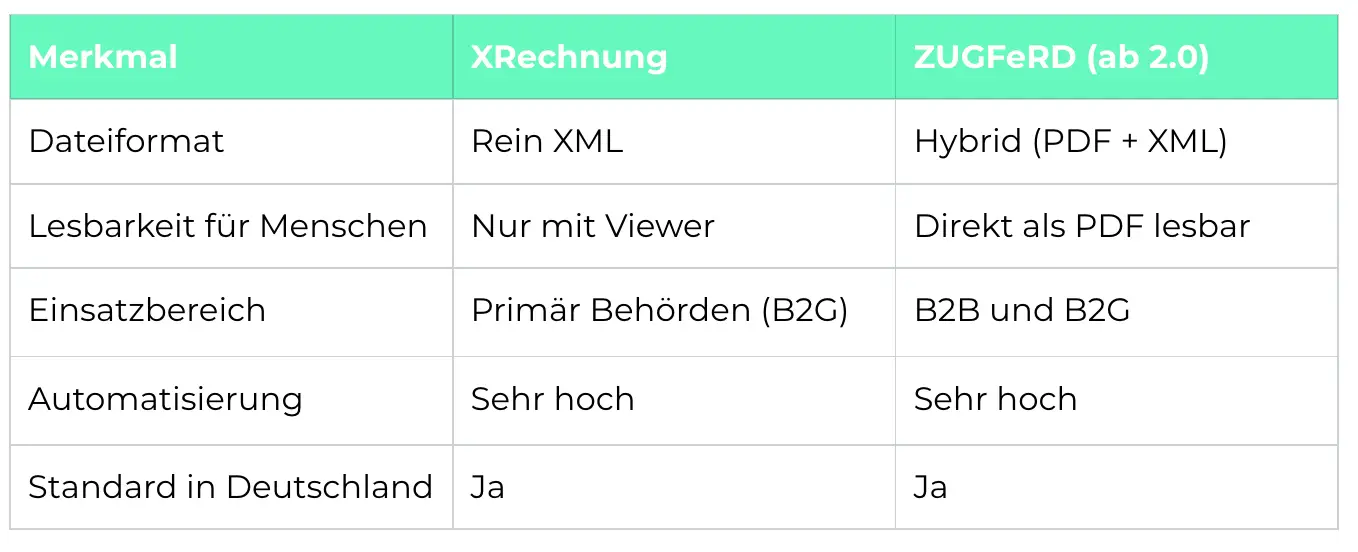
Here’s a quick comparison of the two formats:
Die XRechnung is a purely data-based format. When you open it, all you see is code. This is fantastic for computers and AI systems like Mika, but rather exhausting for the human eye. It is the absolute standard, especially in the area of business-to-government (B2G), i.e. for contracts for public authorities.
ZUGFeRD On the other hand, it is a hybrid format. It combines a visual PDF file with an embedded XML file, so you see a normal invoice while the data is ready for automated processing in the background. For most limited liability companies in the B2B sector, ZUGFeRD is the most charming solution, as it remains legible both for you and for your customers, who may not yet be fully digitized.
Why your GmbH benefits from the early changeover
At mika, we don’t see e-billing as a chore, but as a huge opportunity for your efficiency. Imagine never having to manually type data from an invoice into your banking or accounting system again. Since e-billing provides structured data, an AI can read this information without errors. This reduces the error rate to almost zero percent.
Another decisive factor is liquidity. E-invoices are processed faster. Large companies often have automated workflows that immediately check an e-invoice and approve it for payment. A PDF invoice, on the other hand, often ends up in a manual review process that can take days or weeks. So if you want to get your money faster, you should proactively offer e-invoices to your customers.
You also save money when archiving. Since e-invoices are already digital, there is no need to scan in paper receipts. All you have to do is save them in an audit-proof manner. With a partner like Mika by your side, this happens almost automatically in the background while you take care of your team and customers.
A key advantage that is often overlooked: At mika, every document is automatically checked for accuracy and tax deductibility before it is posted. This fundamentally distinguishes Mika from classic accounting software such as sevDesk or LexOffice, where you book yourself and mistakes are only corrected by a tax advisor. Mika doesn’t make mistakes in the first place.
Checklist: How to make your GmbH 2026 fit
So that you don’t panic on December 31, 2026, we’ve put together a short roadmap for you. You should take these steps over the coming months to make the transition as smooth as possible.
-
Status quo check: Check whether your current software can already generate e-invoices in the XRechnung or ZUGFeRD format (version 2.x). Many old systems need expensive updates or must be replaced for this purpose.
-
Sales forecast 2026: Keep an eye on your figures. Will you exceed the 800,000 euro limit? If so, January 1, 2027 is your deadline for mandatory shipping.
-
Maintain master data: For a correct e-bill, you need clean customer data, in particular the correct email address for receipt of invoices and, if applicable, the route ID with public clients.
-
Define workflow: How do invoices get into your system? Use tools that centralize receipt and delivery. mika can help you with this by bridging the gap between your receipts and the tax authority.
-
Communication: Inform your customers that you are switching to e-invoices. Most people will thank you for it because they want to automate their bookkeeping themselves.
Remember: It’s not just about complying with a law. It’s about setting up your GmbH for the future. A digital workflow is the basis for everything that comes next, from AI-supported financial planning to automated advance sales tax return.
Common mistakes you should avoid in 2026
In our talks with We often hear founders the same myths. One of the most dangerous is the belief that an email with a PDF invoice is an e-invoice. According to the BMF letter dated October 15, 2024, this is simply wrong. A PDF is an “other invoice.” If you are required to e-invoice from 2027 or 2028, you risk your or your customer’s input tax deduction by using simple PDFs.
Another mistake is waiting for the “last minute.” Changing your accounting processes takes time; you need to train your team and ensure that your IT infrastructure works. Anyone who only starts in December 2026 will experience unnecessary stress. Instead, use the quieter phases in 2026 to test mika and digitize your processes step by step.
Don’t underestimate the archiving requirement either. An e-bill must be kept in its original digital format. A printout of the XML file is not enough; you need a system that guarantees the immutability of the data for ten years. It’s not rocket science, but you have to set it up correctly.
Comparison of e-invoice formats
Deadlines for sending invoices
Frequently asked questions (FAQ)
Do I have to send every invoice as an e-bill?
No, the obligation applies primarily to domestic B2B sales. Invoices to private individuals (B2C) or small amounts of less than 250 euros are excluded from the e-bill requirement. There are also currently other rules for cross-border services, but these will change in the next few years as part of the EU-wide VIDA initiative.
How do I calculate the 800,000 euro turnover limit?
The total turnover of your GmbH in the previous calendar year is decisive. Your turnover from 2026 is therefore decisive for the obligation from 2027. This is based on the taxable total turnover in accordance with Section 19 (2) UStG.
Do I need special software for e-invoices?
Yes, since an e-invoice consists of a structured XML data set, you can’t simply create it with Word or Excel. You need accounting software or an AI co-pilot like mika who can generate, receive and archive these formats in an audit-proof manner.
Do I need to confirm receipt of e-invoices?
No, explicit confirmation is not required. Since January 1, 2025, it is assumed that every company is technically able to receive these invoices. You should just make sure that your inbox is ready for these file formats and that they don’t end up in the spam filter.
How does mika help my GmbH with the changeover?
Mika acts as your intelligent co-pilot. The platform automatically recognizes when an e-invoice is received, checks every document for accuracy and tax deductibility, reads out the XML data without errors and prepares the booking. You then submit your advance VAT return directly via the integrated ELSTER interface — without having to contact the tax advisor. When sending, mika ensures that your invoices are always created in the correct format (e.g. ZUGFeRD) so that you and your customers are legally on the safe side.
Other common questions (PAA)
Is a PDF invoice still allowed in 2026?
Yes, a PDF invoice in 2026 is still allowed for delivery by most limited liability companies, provided that the recipient agrees. From 2027 or 2028, however, this will change depending on the volume of turnover, and the PDF will be replaced by structured formats such as XRechnung or ZUGFeRD.
What happens if I ignore the e-billing requirement?
If you are required to issue and do not send a legally compliant e-bill, the invoice is considered incorrect. This can result in your customer losing their input tax deduction, which can impact your business relationship and lead to tax problems.
Does the e-invoicing requirement also apply to small business owners?
Yes, even small business owners must be able to receive e-invoices since January 2025. The same transition periods apply to shipping as for other companies, although most small business owners are only required to ship from 2028.
Which format is better: XRechnung or ZUGFeRD?
It depends on your customers. XRechnung is often mandatory for authorities. ZUGFeRD is usually better suited for general B2B traffic, as it combines a human-readable PDF view with machine-readable XML data.
sources
- e-invoice-wissen.de: https://www.e-rechnung-wissen.de/zugferd-vs-xrechnung
- scopevisio.com: https://www.scopevisio.com/de-at/blog/rechnungseingangsbuch/zugferd-und-xrechnung-zwei-formate-fuer-die-e-rechnung/
- auto.news: https://auto.news/artikel/zdh-umfrage-zur-e-rechnung-und-bewerbungsfrist-fuer-ausbildungs-award-2026
Let Mika tame the bureaucracy monster for you. Start your AI-supported accounting now and get your GmbH ready for the future.